

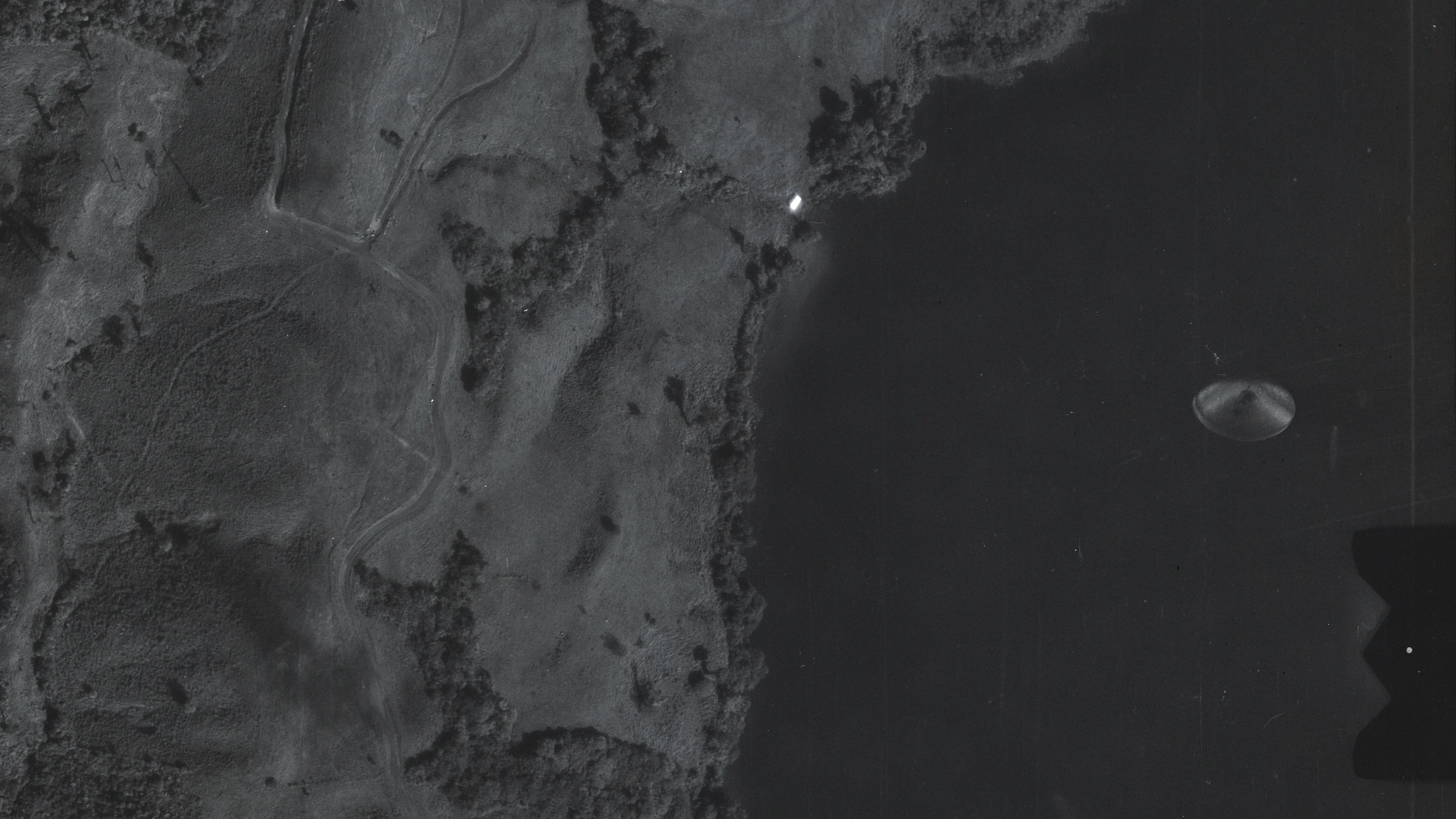

On the morning of September 4, 1971, a twin-engine Aero Commander F680 was flying at approximately 10,000 feet over the northern highlands of Costa Rica. The mission was routine: the National Geographic Institute of Costa Rica (Instituto Geográfico Nacional, IGN) was conducting an aerial survey to assess land and water resources for a planned hydroelectric project near the Arenal Volcano. A 100-pound Zeiss RMK 15/23 aerial mapping camera — a large-format precision instrument mounted on the floor of the aircraft and pointing downward — was automatically photographing the terrain at intervals of roughly 13 to 20 seconds.
The crew consisted of four professionals: aerial photographer and cartographer Sergio Loaiza, pilot Omar Arias, geographer Juan Bravo, and topographer Francisco Reyes. None of them noticed anything unusual during the flight. It was only later, when the negatives were developed and reviewed, that something appeared in frame 300 of the sequence: a sharply defined disc-shaped object, apparently metallic, hovering over Lago Cote, Costa Rica's largest natural freshwater lake. The frames immediately before and after, numbered 299 and 301, showed nothing.
The photograph, now widely known as the Cote Photo, has since become one of the most analyzed UAP images ever produced. What sets it apart is its unbroken chain of custody in the Costa Rican national archive, the fact that it was taken with professional government equipment, and the downward angle onto the dark, uniform surface of the lake. Those conditions eliminate much of the ambiguity that plagues most UAP imagery.
The image was not seriously examined until the 1980s, when physicist and UAP researcher Dr. Jacques Vallée traveled to Costa Rica and obtained the original negative from the government for analysis. Vallée subsequently collaborated with Dr. Richard F. Haines, a research scientist formerly with NASA's Ames Research Center, on a detailed scientific study of the photograph. Their findings were published in two papers in the Journal of Scientific Exploration, in 1989 and 1990. Both papers concluded that the image showed no evidence of optical defects, deliberate hoax, or prosaic explanations, and that the object appeared to be a large, three-dimensional disc.
Because the survey aircraft maintained a fixed, precisely known altitude and the camera's focal length and film format are documented, the scale of the negative is exactly 1:20,000 — meaning one centimeter on the negative corresponds to 200 meters on the ground. The object's diameter on the negative measures approximately 0.42 centimeters, placing its estimated diameter at roughly 84 meters at ground level, assuming the object was at or near the lake's surface. Its actual altitude above the water cannot be determined from the image alone, which means its true size remains a matter of estimation rather than certainty.
The absence of any shadow cast by the object onto the lake surface was noted by both Haines and Vallée. Their interpretation was that the object was likely at or very close to the surface of the water — at such low altitude, no shadow would be expected to fall in a location visible within the frame. Other researchers have proposed additional explanations, including the possibility that the object was partially submerged. No consensus has been reached.
The original negative remains in the custody of the Costa Rican national archive. In 2022, Esteban Carranza, a Costa Rican attorney and UAP researcher, had access to a contact copy of the original negative — inherited from his late uncle, who had obtained it from the National Geographic Institute in the late 1970s or early 1980s. Carranza sent the copy to a photographic laboratory in Kansas, where it was subjected to a Heidelberg Tango drum scanner, a high-precision instrument commonly used for archival and fine-art reproduction. The resulting high-resolution digital scan was made publicly available and offered the most detailed view of the image to date, prompting renewed discussion and analysis within the UAP research community.
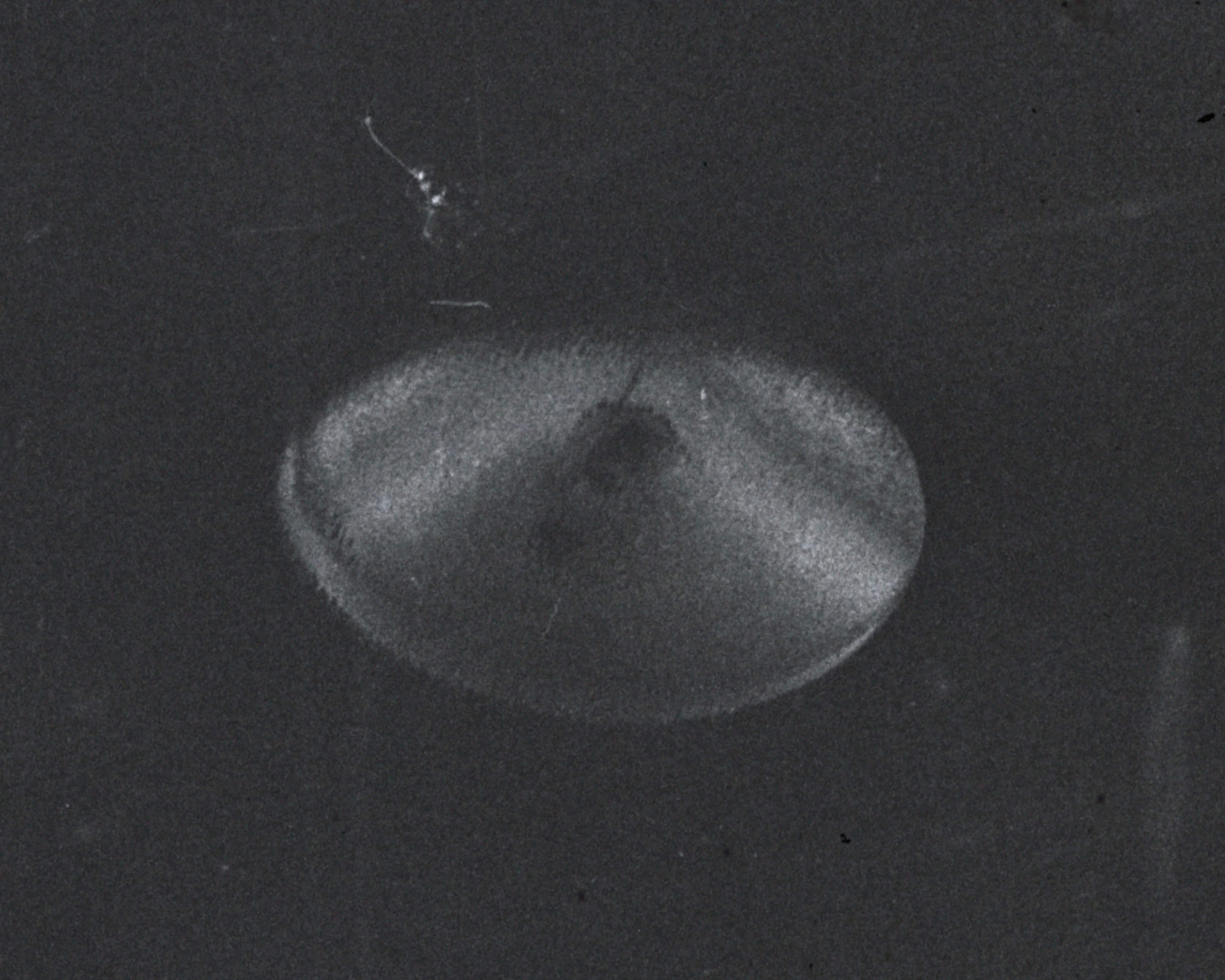
The renewed attention surrounding the image has coincided with a documentary project currently in post-production. The Cote Photo is the debut feature film of Adam Pillon and Megan Woomer, a husband-and-wife filmmaking team based in Detroit, Michigan. The film focuses not on forensic analysis but on the human stories surrounding the photograph: the crew members who took it, the researchers who have spent decades examining it, and the broader community of experiencers connected to the Lago Cote area.
The documentary features Sergio Loaiza, now elderly, speaking on record for what appears to be one of the first times in depth about both the 1971 flight and UAP-related experiences he describes having had earlier in his life. It also features investigative journalist and author Leslie Kean, who co-authored the 2017 New York Times investigation that revealed the Pentagon's Advanced Aerospace Threat Identification Program (AATIP); Esteban Carranza, who drove the high-resolution scan effort; and analyst Michael Strickland, the Kansas-based photographer who performed the drum scan. A summer 2026 release is planned, with festival submissions underway.
The UAP Observer spoke with director Adam Pillon about the project.
Q: Please tell us in more detail how you first encountered this photo in Costa Rica — where and when did you see it, and why did it leave such a strong impression on you?
A: "My wife, Megan Woomer, and I are filmmakers from Detroit, Michigan. Megan was visiting her friend Kelli in Costa Rica. Kelli lives in a bright pink house with jaw-dropping views of the Arenal Volcano. She has a print of The Cote Photo hanging on her wall. Kelli shared with Megan the most fascinating story of her own UAP experience. When Megan returned home from her trip, she insisted we make a documentary about the photo. I agreed on the spot. A few emails and phone calls later, we found Esteban Carranza. We joke that he answered the phone as if he were expecting our call. The positive energy from everyone we encountered compelled us to keep going. This photo captivates you. It makes you want more."
Q: Can you summarize for our readers what the documentary is about and what you want audiences to take away from it?
A: "This film is about the power of one photo. A moment frozen in time. We shine a spotlight on that moment. It's analog in a digital world. To some, it's evidence of non-human intelligence; to others, it's a flying VW hubcap. This film presents the photo for you to make your own assessment. It gives the participants a platform to share their stories. It's amazing what frequencies you can hear when you take the time to listen."
Q: How did you convince Sergio Loaiza to open up and talk after decades of relative silence?
A: "Esteban and Sergio have known each other for years, and Esteban was able to get us in contact. Neither Megan nor I speak Spanish, and Sergio speaks very little English. Megan used translation apps to communicate with Sergio. They spent all day texting back and forth. Sometimes about the photo, but more often about life, family, friends, the things that make us who we are. They talked as if they had known each other for years. By the time we got to Costa Rica to start filming, we felt as if we had our own little extended family there. As Sergio says in the film, 'It's time to start sharing their stories.'"
Q: Without spoiling the film — can you share a little about the UAP-related experiences Sergio had prior to the 1971 mapping flight?
A: "I'll save those details for the film. I think it's best you hear it directly from him."
Q: You also interviewed other UAP experiencers for the documentary. What have you learned from them, and is there a common theme in their stories?
A: "The other [two] UAP experiencers we interviewed are very different personality-wise. Emi is very shy — she is the kindest, most genuine person. Kelli is very confident, eccentric, and 'out-there.' Both stories relate to the Cote Photo in some way, but I've learned that experiences come in all shapes and sizes."
Q: How has this project affected you personally? Has making this documentary changed you in any way?
A: "Making this documentary has been one of my greatest adventures. It took me to the jungles of Costa Rica, the Great Plains of Kansas, and the crowded streets of [New York City]. I've made new friendships and strengthened old ones. Through it all, my family was by my side to share in the experience. My wife Megan is our fearless leader into the unknown. She's always chasing the essence of life. We created core memories for our children. My youngest son can recite parts of the movie by heart, and my oldest son remains its biggest skeptic, but they both will remember the time our family went to Costa Rica and broke bread with Don Sergio."
Q: The world has changed a lot around this subject since 1971. Do you feel the current momentum around UAP disclosure gives the Cote Photo a different weight or urgency than it had before?
A: "Whistleblowers often can't share the extent of their knowledge. Some information remains confidential, reserved for people with the right clearances. Cote is on the surface for anybody to see. It was there before Photoshop, drones, and AI. It has an undisputed chain of custody. It stands up to scrutiny. Disclosure is on the way. This photo helped pave the path."
Q: Your website mentions a summer 2026 release. Is there a distribution plan in place — will the film premiere at a festival?
A: "We submitted The Cote Photo to a few film festivals. We don't have an exact premiere date yet, but we're excited to share more information soon. 2026 will be an exciting year."
The Cote Photo remains one of the few UAP images that has resisted straightforward debunking by credentialed researchers. But as Pillon makes clear, the documentary was never about reaching a verdict. As he puts it in his director's statement, the film is about "the humility of saying we don't know — and allowing that to be enough." In a field that rarely tolerates uncertainty, that may be its most distinctive quality.
Adam Pillon and Megan Woomer are the directors of The Cote Photo, currently in post-production and scheduled for release in summer 2026. Further information, including a link to download the high-resolution scan of the original negative, is available at cotethedocumentary.com.