
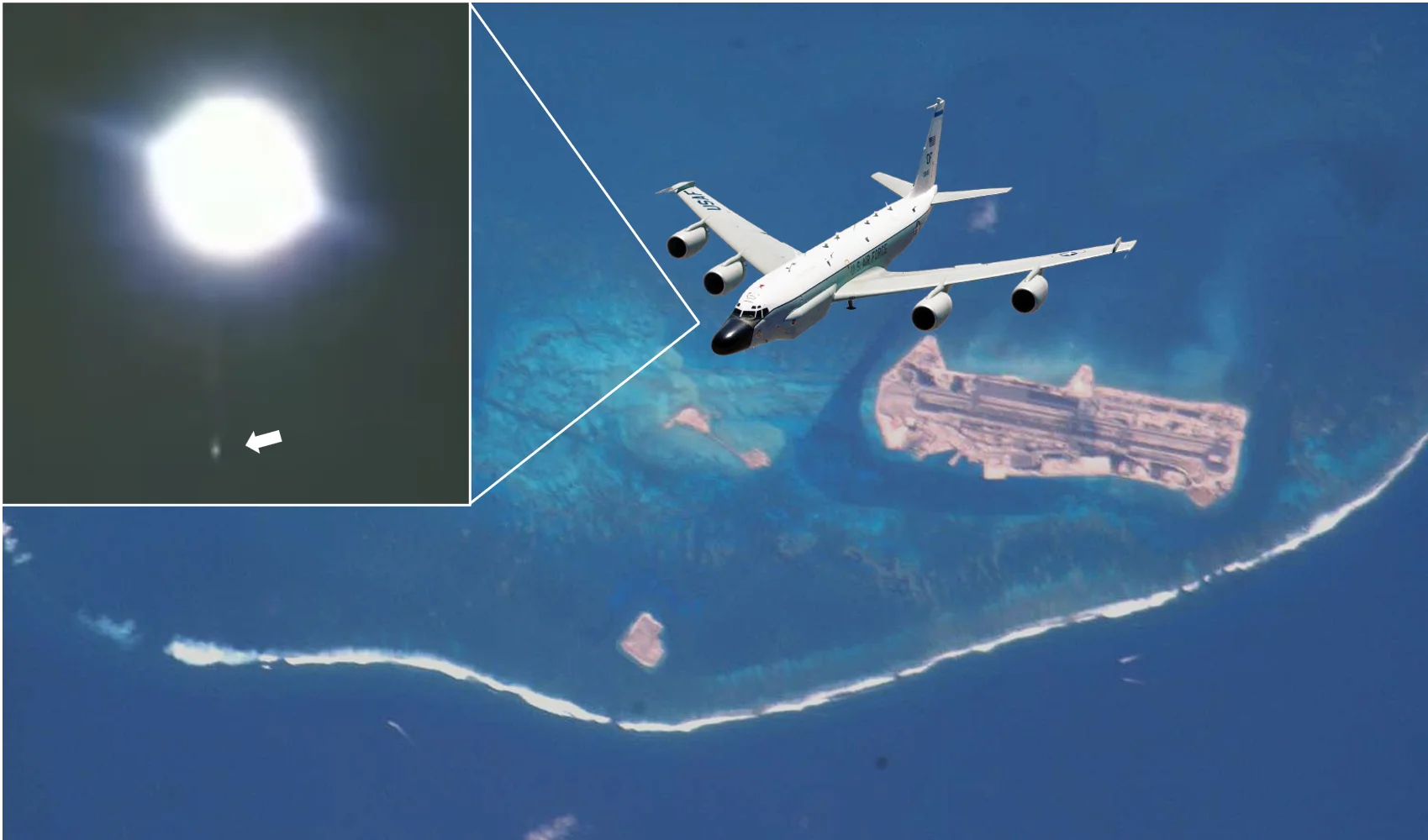

At 00:01 on October 26, 1962, at the height of the Cuban Missile Crisis, the United States detonated a thermonuclear device roughly 48 kilometers above Johnston Island in the central Pacific. The test was called Bluegill Triple Prime, and it was the fourth attempt to fire the same weapon. Three earlier tries had each ended in failure, one of them spectacularly, when a booster exploded on the launch pad and contaminated the island with weapons-grade plutonium. The test was part of Operation Fishbowl, a program to study whether high-altitude nuclear blasts could destroy incoming Soviet warheads using a burst of X-ray energy.
Two instrumented KC-135 aircraft, code-named KETTLE 1 and KETTLE 2, filmed the detonation with ultra-high-speed cameras. When portions of the footage were partially declassified in 1998, something unexpected appeared. In the KETTLE 2 footage, a large object can be seen tumbling out of the nuclear fireball and falling toward the ocean. In the corresponding section of the KETTLE 1 footage, operated by a different laboratory, the same area has been covered with a white triangular redaction. Of all the high-speed test footage from Operation Fishbowl released in 1998, only the Bluegill Triple Prime material retains a classified portion. Under a 2012 Department of Energy ruling, it will remain so until 2062.
That footage is what first drew Geoffrey Cruickshank, a former intelligence officer and security consultant, to the story. To understand his hypothesis, it helps to look at an event 37 days earlier. On September 19, 1962, a U.S. Air Force Atlas 8F ICBM was launched from Cape Canaveral, carrying the same type of re-entry vehicle that would later be used in the Bluegill test. Footage from that mission, now held in the U.S. National Archives under Records of the Office of the Secretary of Defense, shows an unidentified object appearing alongside the re-entry vehicle as it descends at roughly Mach 18. It keeps pace for about 90 seconds before vanishing. The post-flight test report noted that objects had been filmed whose "origin or identification could not be determined." AARO later assessed the footage as suitable for the National Archives UAP catalog. Cruickshank's core argument is that a UAP was monitoring this specific type of re-entry vehicle in both incidents, and that in the second, the nuclear warhead detonated while the object was still there. Project Blue Book files also document UAP sightings near Johnston Island in the hours directly before and after the test.
This reading connects to a well-known episode in the modern UAP disclosure movement. In a 2016 radio interview, Tom DeLonge described being told by high-level USAF insiders that during the Cuban Missile Crisis, "there was a small group of people on both sides that were trying to do exactly what they did, which was fly swat some bugs out of the sky." Days after that interview aired, emails from the DNC WikiLeaks release confirmed DeLonge had been in contact with USAF Generals Neil McCasland and Mike Cleary, and with presidential campaign manager John Podesta, in the months prior. Cruickshank opens his research paper with this quote.
The research itself is a collaborative effort. The core paper, "Bluegill Triple Prime: The Recovery Operation", was published on LinkedIn by Cruickshank together with Caren Gallaudet, a retired U.S. Navy diver, and Rear Admiral Tim Gallaudet, Ph.D., U.S. Navy (ret.), a former Oceanographer of the U.S. Navy. Both know what a naval watchkeeper's log is supposed to say, and what it means when it doesn't.
After the detonation, the official account holds that all three instrumented pods from the test were recovered by 09:00 on October 26. Yet five Navy vessels continued searching the area for days, and their deck logs do not tell a consistent story. Debris transfers are recorded by one ship but not by the vessels directly involved. USS Safeguard lost all power while hauling an unusual object aboard. A fuel transfer from USS Princeton to USS McCain was logged without volume or fuel type, the only such omission in that ship's logs for the entire month. On October 28, an urgent signal from Pearl Harbor dispatched fleet tug USS Abnaki and specialist barge YFNB-13 to Johnston Island. YFNB-13 was no ordinary barge: it had been fitted with underwater cameras by EG&G for the 1955 Wigwam nuclear test. The 1983 Kaman Tempo report found that every single crewmember of USS Tuscumbia, another vessel deployed to the area, had received higher than expected radiation exposure despite having no official duties near any radiation source.
What the ships may have found is described, second-hand, by David Noble Whitecrow, a former U.S. Navy sailor. In a 2018 recorded interview, he related a conversation from 1976 with a retiring Master Chief who described being part of a classified dive operation near Johnston Island. The Chief was the first diver in. He found an enormous cylindrical object on the seafloor, so large he initially mistook it for a cliff face. When he put his hand to its surface, his hand went inside. The object lit up the entire sea floor. He was evacuated to Pearl Harbor and refused to dive again. His service records, reviewed by Cruickshank, contain an unexplained gap in employment covering exactly that period. According to Whitecrow, the object eventually rose from the water and moved away under its own power, beyond sonar range, before any recovery could be completed. This account has not been independently verified through documentary sources and is presented here as testimony.
One more document now sits in the public record. The Department of War's first PURSUE release, published on May 8, 2026, included a July 1963 memo titled "Thoughts on the Space Alien Race Question", written by Maxwell Hunter, the engineer who designed the Thor missile used to carry the Bluegill warhead, and who had been present on Johnston Island for the test. He wrote it seven months after the detonation, addressed to the State Department.
Not everyone finds the case compelling. Researcher Douglas Dean Johnson has argued that the tumbling object in the footage is simply the spent Thor booster, and that the deck log anomalies are consistent with routine post-test debris recovery. Cruickshank disputes both claims at length, and addresses them directly in the interview that follows.
Q: The Atlas 8F test on September 19, 1962 — 37 days before Bluegill — filmed a UAP tracking the same Avco Mk IV re-entry vehicle at Mach 18 for 90 seconds. Do you think it's the same type of craft that appeared over Johnston Island five weeks later?
A: "It is hard to get an idea of the size of the craft inspecting the Avco Mark IV re-entry vehicle in the Atlas 8F incident. The object appeared smaller than the RV, whose dimensions were 3.22 meters in length, with a diameter of 0.82 meters and flare of 1.22 meters. We know from the post-test reports of the Bluegill Triple Prime test that the fireball in the KETTLE 2 footage is about 900 meters in diameter. Comparing this dimension to the object that tumbles out of the fireball, the object appears to be between 50 and 100 meters in length. The object described by the Master Chief is also cylindrical but described as 'larger than an aircraft carrier' — in the case of the Nimitz class, this would be 330 meters long by 45 meters wide. As I said, it is hard to judge the dimensions though. I believe that the UFO interfering with an ICBM re-entry vehicle filmed by Bob Jacobs during the Atlas 245D flight of September 15, 1964 was also related to these incidents."
Q: Douglas Johnson argued the object in the KETTLE 1 footage is simply the spent Thor booster. Your ballistic coefficient calculations and flight telemetry data make that physically impossible. For readers without a physics background, what's the simplest way to explain why the booster couldn't have been there?
A: "Doug's very basic mistake was that he thought the Thor missile flew to an altitude of 900 km [at] apogee and then travelled back down towards the Earth, releasing the RV on the way back down. I was really shocked that he could make such a blunder. In fact, the Thor missile separated from the Avco Mark IV re-entry vehicle at an altitude of 187 kilometers, after 176.4 seconds of flight time. The RV continued its flight up to the 900 km apogee point, whilst retro-rockets in the booster fired, pushing the booster backwards and sideways. The booster started falling back to Earth immediately at that stage of the flight, whilst the RV continued on its trajectory for another 14 minutes, before the warhead detonated at a height of 48 kilometers. The fact that the booster started its descent 14 minutes before the detonation, plus the fact that the retro-rockets pushed it backwards and sideways, makes it impossible for the booster to be at the same point in space and time as the detonation."
Q: Maxwell Hunter designed the Thor missile, was called to Johnston Island after three failures, and witnessed the test firsthand. The May 2026 DoW PURSUE file release includes a letter he wrote seven months later to the State Department titled "Thoughts on the Space Alien Race Question." What do you think he understood after that night that others didn't?
A: "Max Hunter understood that both the US and the Soviet Union were racing to blast a UFO out of the sky with nuclear weapons, as Tom DeLonge's radio interview described 54 years later. On October 22, 1962, at the height of the Cuban Missile Crisis and just four days before the Bluegill Triple Prime test, the Soviet Union conducted one of the most significant high-altitude nuclear tests of the Cold War: the K-3 test, part of the Soviet 'Project K' series over Kazakhstan. The detonation demonstrated the destructive potential of EMP effects on modern technological infrastructure. The K-3 detonation caused major disruptions hundreds of kilometres from the burst point. Reports released after the collapse of the Soviet Union revealed that the EMP damaged civilian and military infrastructure across Kazakhstan. A 570-kilometre buried telephone line between Aqmola and Almaty suffered severe damage, with protective devices destroyed by induced currents. Sections of the electrical grid failed, transformers were damaged, and power stations experienced outages. One of the most striking effects involved a power plant in the city of Karaganda. The EMP induced currents large enough to trigger fires and destroy electrical equipment. The K-3 test was especially alarming because the effects extended far beyond the expected blast radius of a conventional nuclear weapon. Unlike thermal or shock effects, EMP could impact an enormous geographic area simultaneously. The Soviet Project K tests paralleled American discoveries from the July 1962 Starfish Prime test, where streetlights failed in Hawaii nearly 1,500 kilometres away. Together, the Soviet and American experiments fundamentally changed military thinking about nuclear warfare, command-and-control survivability, and infrastructure vulnerability. Max Hunter knew if the 'race' continued, it could eventuate in the elimination of our species. He also knew other species were watching our developments, and as such penned the letter to the State Department."
Q: The deck logs show a debris transfer from the Safeguard to the McCain on October 26, recorded by the Engage — but neither the Safeguard nor the McCain mention it in their own logs. Then there's the Princeton-to-McCain "fuel transfer" with no volume or fuel type logged, unlike every other refueling that month. What do you think was actually being moved around?
A: "The fact that all of the instrumentation pods from the Bluegill Triple Prime test were recovered by 08:00 on October 26, 1962, and that the McCain, Engage and Safeguard continued searching, tells me that the craft was damaged by the nuclear detonation and these vessels were collecting the debris. According to the deck logs, the Safeguard lost all power momentarily whilst hauling a pod aboard — which is unusual because its two diesel direct-current generators were powering separate buses when the power loss occurred. The Princeton was the flagship of Joint Task Force 8, and was where Major General Alfred Starbird and his deputy, Rear Admiral Lloyd Mustin, were based during Operation Dominic. The urgent message that was sent to Pearl Harbor on the afternoon of Sunday, October 28, 1962, that requested the USS Abnaki tow the specialist barge YFNB-13 to Johnston Island immediately for the recovery mission, probably originated from the Princeton after inspection of the debris."
Q: According to Whitecrow, the diver's shipmates told him that after his evacuation, a whole flotilla assembled at the site — including submarines taking soundings. Have you been able to find any records of submarines being dispatched to the Bluegill Triple Prime area in late October or November 1962?
A: "They didn't need submarines — they had something far better. YFNB-13 was fitted out with instrumentation and underwater cameras by EG&G for the 1955 Wigwam test, and because the Master Chief said that sunlight was shimmering through the water when he dived on the downed craft, we know that the depth was only around 20 to 30 meters, as he did not conduct a decompression stop during the ascent. This was the perfect depth for YFNB-13 to carry out an inspection mission of the object. The fact that it spent less than a week on station aligns with what the Master Chief told Whitecrow — the craft managed to escape under its own steam."
Q: The Department of War has committed to ongoing UAP file releases through the PURSUE program. Are there specific documents you're watching for in future releases that could further substantiate the Bluegill case?
A: "The Bluegill Triple Prime test was primarily an Atomic Energy Commission / Armed Forces Special Weapons project — the CIA was completely out of the loop. The incident was reported back to President Kennedy via his sources in the U.S. Navy, bypassing the normal CIA stonewalls. This forced James Angleton and the CIA to 'come clean' to the President about the alien presence during the Cuban Missile Crisis, lest it provided ammunition for Kennedy to 'destroy the CIA and spread its ashes to the wind.' I am not hopeful of AEC/DOE documents being released, because they have not been cooperating at all with the PURSUE team and would not willingly give them up. I think I have enough evidence now anyhow."
Several threads remain open. As of the second PURSUE release, published on May 22, 2026, the fully unredacted KETTLE footage from the Bluegill test has not surfaced in either release. The Maxwell Hunter letter is publicly accessible through the PURSUE archive. The missing deck logs of USNS Point Barrow, last noted as absent in 1983, remain unaccounted for. Cruickshank has indicated he is able to provide the names and service records of Navy personnel who may have had direct involvement in the incident to properly credentialed investigators, if required.
Geoffrey Cruickshank is a former intelligence officer and security consultant based in Darwin, Northern Territory, Australia. He is a Member of the Scientific Coalition for UAP Studies and the Institute for Electrical and Electronics Engineers. His research is published at geoffcruickshank.substack.com.