

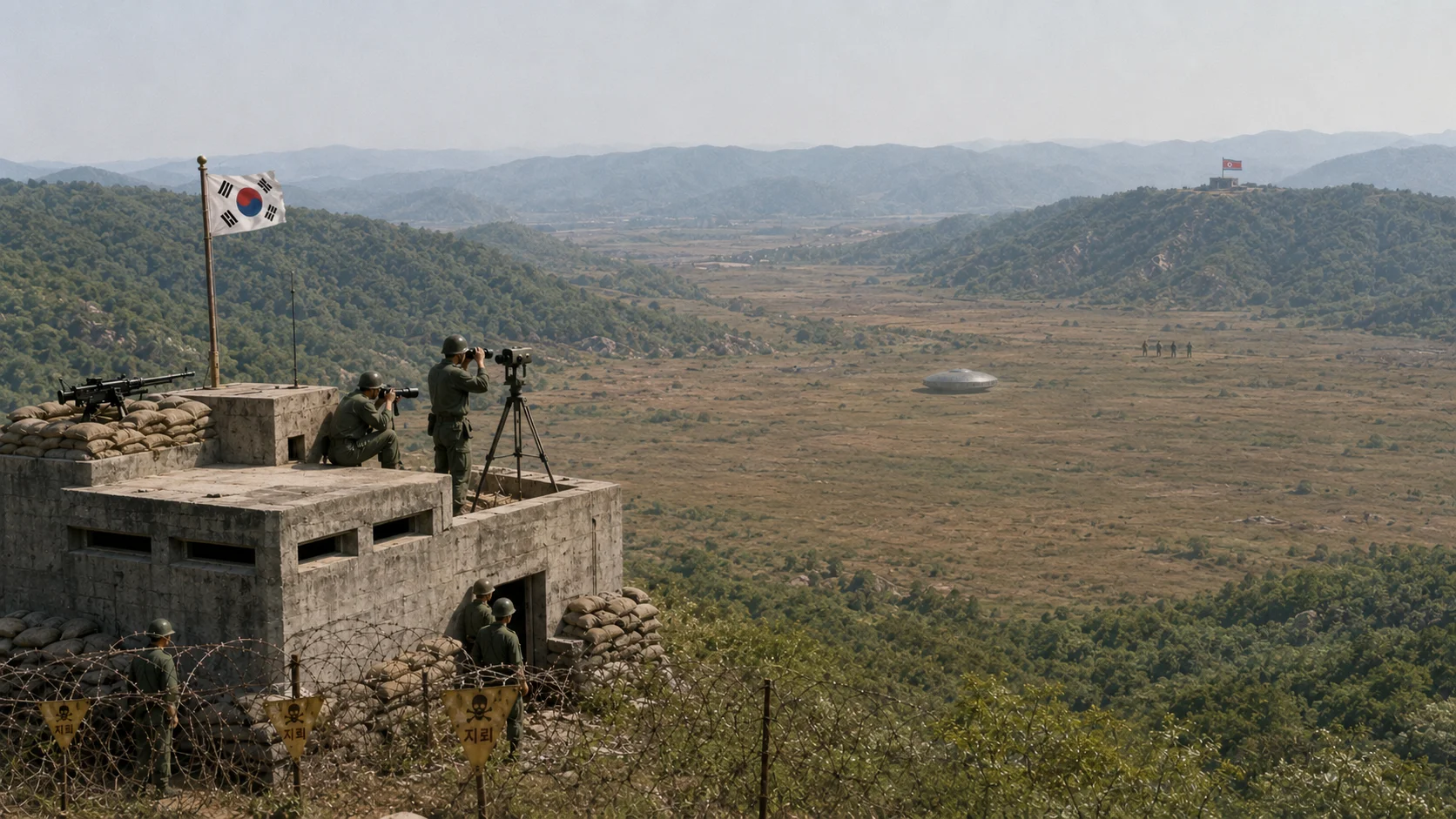

In the spring of 1982, while conducting routine artillery observation at a frontline post deep inside the Korean Demilitarized Zone (DMZ), a corporal of the Republic of Korea Army spotted an unidentified silver object sitting in an open field roughly 900 meters away, inside enemy territory. He reported it up the chain of command. His superiors ordered him to photograph it, and he did. He would not speak of it publicly for more than forty years.
Bae Seong-deok, now 67 years old, served as a situation soldier at GP 853, part of the 21st Infantry Division's 65th Regiment, in Yanggu County, Gangwon Province. After retiring from the Korea Electric Power Corporation (KEPCO) in September 2019, following a 34-year career, he reported the incident to the Korean UAP Society, led by Professor Maeng Sung-ryul of Woosuk University. The case was subsequently forwarded to Seo Jong-han, head of the Korea UFO Investigation and Analysis Center, who has been investigating UAP reports from the Korean peninsula for forty-five years. Seo's center conducted a multi-session investigation, including a face-to-face video interview with Bae in Daegu. In May 2026, Seo gave an interview to The UAP Observer (TUO), providing additional details on the case.
To understand what is being described, some context is necessary. The Korean DMZ is a strip of terrain roughly 250 kilometers (about 155 miles) long and four kilometers wide, separating South Korea from North Korea. Its center is marked by the Military Demarcation Line, established under the 1953 armistice that ended the Korean War. Despite its name, it is one of the most heavily fortified areas on Earth, with heavily mined terrain, multiple layers of barbed wire, and surveillance outposts manned continuously by both sides. Guard Posts, known as GPs, are frontline surveillance fortifications located inside the DMZ itself, positioned forward of the General Outpost (GOP) line on the Southern Limit Line. They are reinforced concrete structures, typically housing thirty to fifty personnel, whose occupants officially operate under civil police designation under the armistice terms. Visits by senior officers are rare events requiring explicit authorization from the United Nations Command (UNC). GP 853, where Bae served, sat on the high ground of Baekseoksan Mountain in the rugged operational area of the 21st Infantry Division, nicknamed the "Baekdusan" Division, headquartered in Yanggu County. The division is responsible for the Gangwon Province sector of the DMZ, a region of steep mountain terrain along the North Korean border.
According to the investigation report, the incident began at approximately 1:30 p.m. on May 23, 1982. GP 853 was then staffed by thirty-two personnel: one artillery observation officer, one artillery observer, and thirty GP soldiers. The artillery observer, performing routine fire direction training, spotted an unidentified object through his artillery scope in an open field inside the DMZ. He immediately alerted Bae, the operations clerk on duty. Bae confirmed the sighting through the observation telescope in the situation room. The object appeared silver-gray in color, sitting stationary in the DMZ grassland. Bae reported it to his superior, the 65th Regiment. Approximately twenty minutes later, orders arrived from divisional command: proceed to the site, document the object, and take measurements.
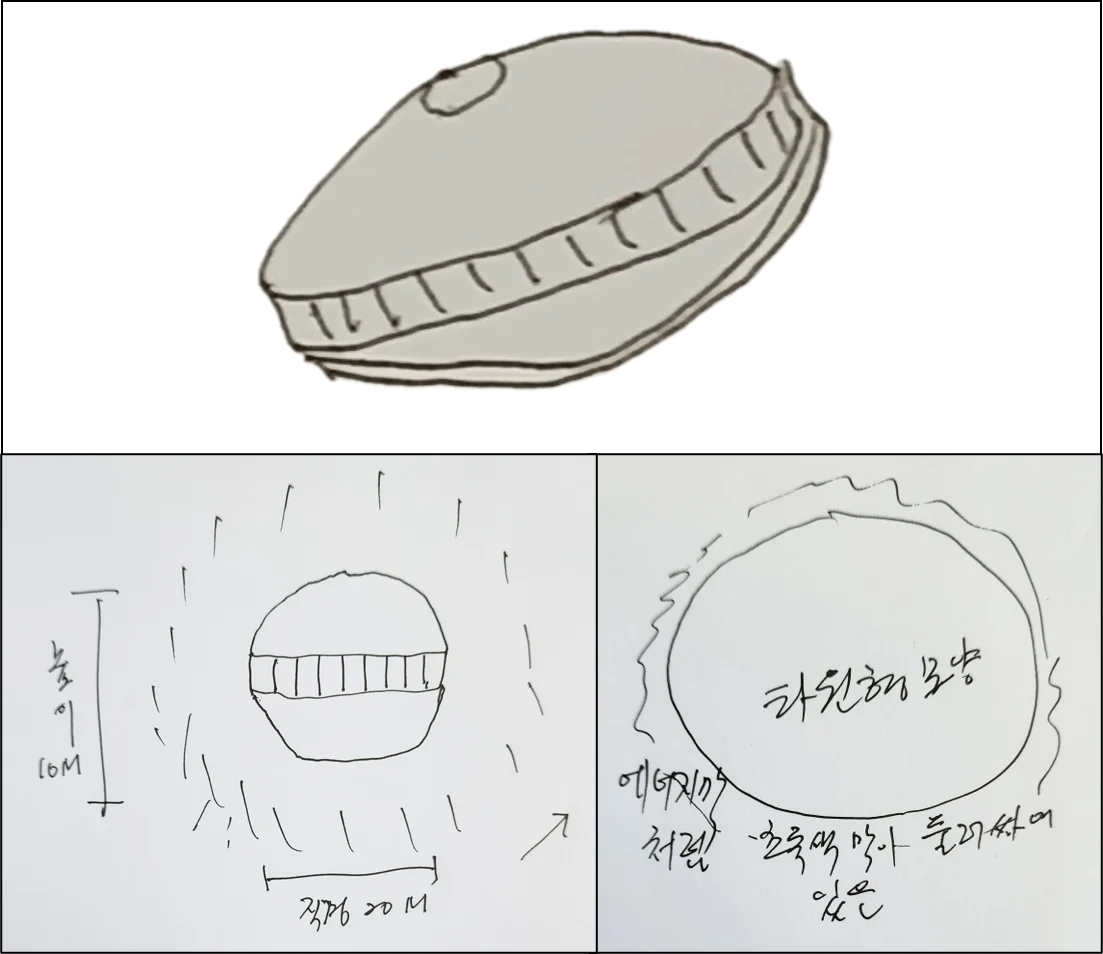
Bae took two privates, left GP 853, and descended some 900 meters down the mountain toward the landing site, taking approximately twenty photographs with a film camera along the way. Using triangulation from his position, his party calculated the object's dimensions at approximately 20 meters in diameter and 10 meters in height, roughly the height of a three-story building.
At approximately 900 meters' range, the situation became more complicated. As Seo confirmed to TUO, six soldiers from North Korea's 129th Civil Guard Battalion had already entered the DMZ from the north and were observing the object from a distance, but did not approach it further. Concerned about the risk of an armed incident, the South Korean party remained in position for five to six minutes, then withdrew, dispatching the film to the regiment via courier.
The object remained stationary inside the DMZ for approximately three and a half hours. At around 5:00 p.m., it began to move. It rose slowly from the field and flew in the direction of GP 853. All thirty GP personnel came outside the bunker to observe. As the object approached, Bae says its appearance changed: the silver-gray hull was now surrounded by what he described as a pulsating green field, a shimmering curtain of light flickering around the entire craft. It hovered approximately 20 meters above the post's machine gun emplacement for roughly thirty seconds. The sound it produced was a low hum, which Bae compared to that of an electric vehicle in motion. Seo confirmed to TUO that no physical effects on personnel or equipment were reported, adding that no personal electronic devices were in use at the post at the time.
Without any visible acceleration, the object then moved to a position above the 7th Division's sector, approximately 15 kilometers away, in what Bae described as under one second. It returned to GP 853 in an equally short time, repeated these transits several times, and also performed zigzag and diagonal maneuvers before finally climbing upward and disappearing. The following spring, Bae verified through his artillery scope that no grass had grown at the landing site, despite the surrounding vegetation having recovered normally after the winter snow melt. Seo confirmed to TUO that no radiographic measurements or soil investigations were ever conducted at the site by military units.
Bae produced three hand-drawn sketches of the object as part of the investigation, shown here: a side profile of the disc, a dimensioned front view, and a top-down view of the object surrounded by the green energy field.
Seo is a well-known figure in Korean UAP research, having contributed to Korean and international media over several decades. He confirmed Bae's unit details and found the account consistent with the GP's known operational profile, though he acknowledged he could not independently verify the encounter itself through official records.
One element of corroboration came from a viewer, Han Hyo-seop, 51 years old, who reached out unsolicited after Seo published the case on YouTube. Han had served at a 7th Division GP in 1997 and, as Seo relayed to TUO, noted that Bae's knowledge of GP structure, personnel numbers, and local terrain indicated genuine firsthand experience: "only those who had worked in the field knew the situation well."
Bae also described to investigators a visit made to GP 853 by General Lee Jin-sam, the 21st Division commander, approximately four to five months after the incident. Such visits require UNC authorization and are not routine events. According to Bae, as relayed by Seo, the general spent some five minutes observing the landing area through a high-powered gunnery scope, without speaking directly to Bae or acknowledging his report. Bae speculated the general had been briefed beforehand and came out of curiosity about what had been reported.
The scarcity of surviving witnesses is itself a matter of record. In his interview with TUO, Seo described a major landmine accident that occurred inside the DMZ in approximately May 1983, when a military dog reportedly triggered an anti-personnel mine during routine vegetation clearing. Approximately half of GP 853's platoon members were killed. Bae had been transferred to a rear unit a month before his discharge in June 1983 and was not present. According to Seo, the incident was almost certainly treated as classified, and no public record of it has been located.
The account presents characteristics that appear in other credible UAP reports, several of which align with what investigators call the five observables: apparent positive lift without visible propulsion, instantaneous acceleration, and hypersonic velocity without audible or thermal signatures. A transit of some 15 kilometers in under one second, if taken at face value, implies speeds far beyond any known aerospace technology. The vegetation anomaly the following spring adds a physical trace to the record, consistent with the class of UAP landing evidence extensively documented by Jacques Vallée, notably in his Confrontations (1990).
Whether any military documentation of the incident survives remains unknown. South Korea has no formal UAP reporting or declassification mechanism, and no established pathway currently exists through which historical military records from this period might surface.
No formal inquiry has yet been made to the South Korean Ministry of National Defense. Seo told TUO that he plans to file an information disclosure request, though he was candid about his expectations of receiving a substantive response after so many years. Bae Seong-deok, now 67, says what has stayed with him most was a quieter puzzle: why did whatever he saw sit motionless inside a militarized no-man's-land for three and a half hours? With his background in mathematics and physics, he offered a careful speculation: perhaps it had run low on energy, or something had malfunctioned.
Forty-four years later, the field has long grown back — the questions it raised have not.
Seo Jong-han is the director of the Korea UFO Investigation and Analysis Center and has been investigating UAP reports from the Korean peninsula for forty-five years. His work has been cited in Korean and international media. The center's investigation report on this case is publicly available at the Internet Archive. The full video interview with Bae Seong-deok, with English narration, is available on his YouTube channel.