

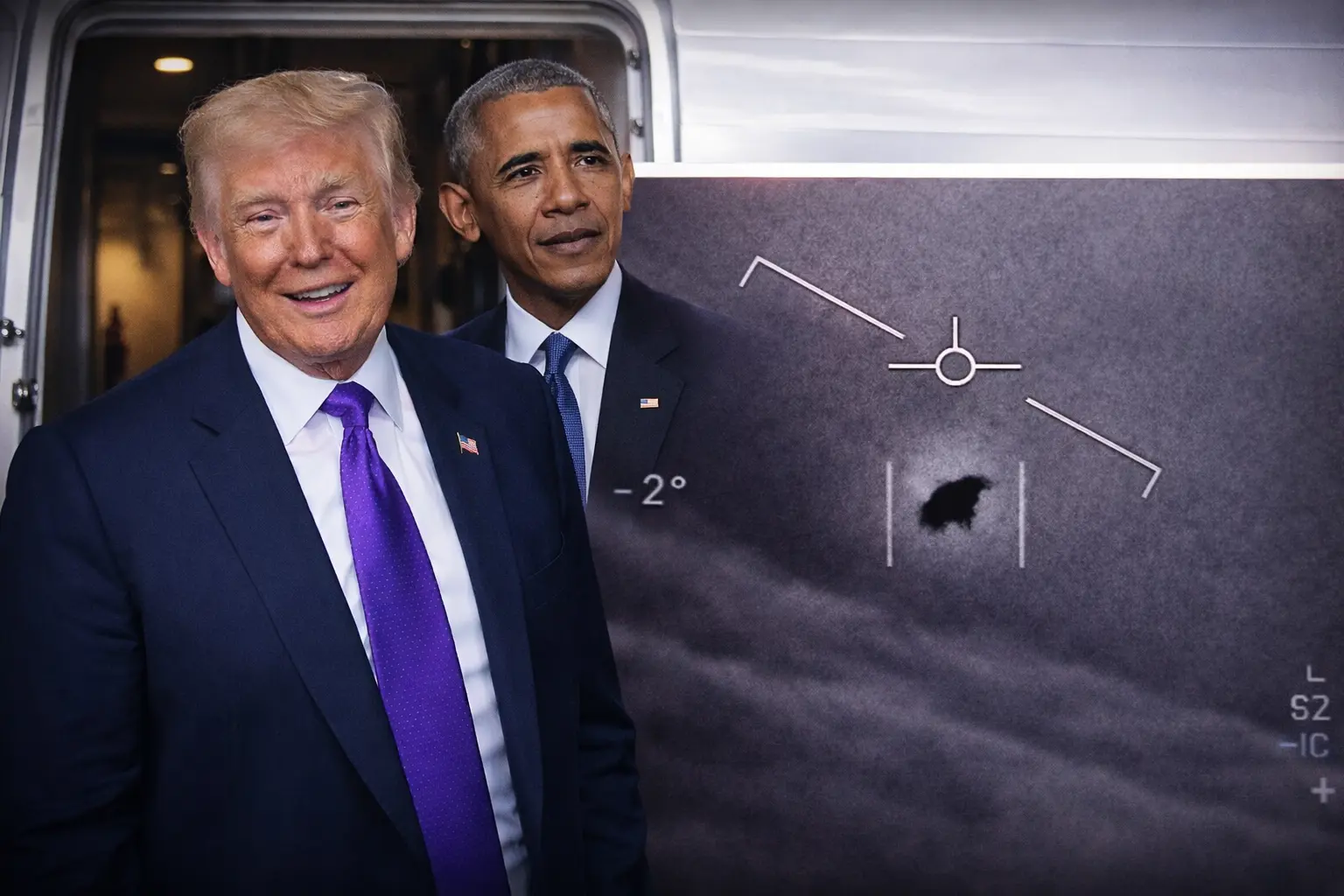

On February 19, 2026, Donald Trump made a remarkable announcement on Truth Social: The Pentagon and other federal agencies are to identify and release government files on unidentified aerial phenomena (UAPs, formerly UFOs) and extraterrestrial life. The trigger was apparently a podcast appearance by former President Barack Obama, in which he hinted that extraterrestrials are "real" — thereby revealing classified information, in Trump's view.
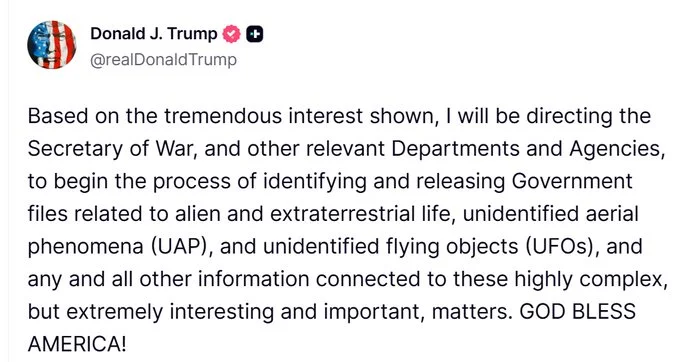
Trump said aboard Air Force One that he could "help Obama out of a bind" by simply releasing the relevant files. Whether the announcement is more of a political calculation remains to be seen.
Reactions to the announcement varied. Luis Elizondo, a former Pentagon insider and well-known disclosure activist, thanked President Trump and his administration on X, as well as the whistleblowers and media who "made this moment possible." At the same time, he pointed out the sheer volume of information that may be stored by intelligence agencies, the Department of Defense, and the Department of Energy. He sees this as an "enormous task" and Trump's announcement as a first step – but only the first.
Christopher Mellon, former Deputy Assistant Secretary of Defense for Intelligence, put it this way: "This might be a consequential moment, but the impact will depend on the follow-through." At the same time, he pointed out that AARO – the Pentagon's official UAP office – is already failing to meet its legal obligations. He was referring to two reports mandated by Congress that are long overdue. If authorities are already failing to deliver what they should have done long ago, why should things be any different now?
Not everyone shared the expectations of those advocating disclosure. Sean Kirkpatrick, former director of AARO, expects "no new insights." He told Scientific American that there is no evidence that UAP sightings are extraterrestrial in nature. In his assessment, there is a tendency to sensationalize sightings for which there is little reliable data. This is a direct rejection of one of the whistleblowers' core claims.
Australian investigative journalist Ross Coulthart, known for his work at NewsNation, pointed out an important point: Trump did not use the word "declassification" once. Without that word—in a formal document, not a social media post—the announcement has no legal binding force.
Coulthart recalled the JFK Records Act of 1992: At that time, under President George H.W. Bush, a comprehensive law was passed to release files related to the assassination of J.F. Kennedy. Nevertheless, it took over 30 years for relevant documents to actually be published.
There is also a structural problem: private defense contractors such as Lockheed Martin, Northrop Grumman, and Raytheon are not affected by Trump's directive. These companies operate under contracts with national security clauses that even a president cannot unilaterally revoke. Several whistleblowers, including David Grusch and Jake Barber, have testified under oath that these companies are said to have access to non-human technology.
Coulthart brought another aspect into play: the timing of the announcement coincided conspicuously with the ongoing revelations surrounding the Epstein files. He does not rule out that the announcement serves at least in part as a diversionary tactic – and that Trump could have significantly less room for maneuver after the 2026 midterms. If the Pentagon wants to play for time, all it has to do is wait.
The varying reactions show how divided the public is on the UAP issue. The decisive factor will be whether Trump signs a binding executive order – or whether it remains a political announcement. The answer will show how serious the US government really is about transparency on the UAP issue.