

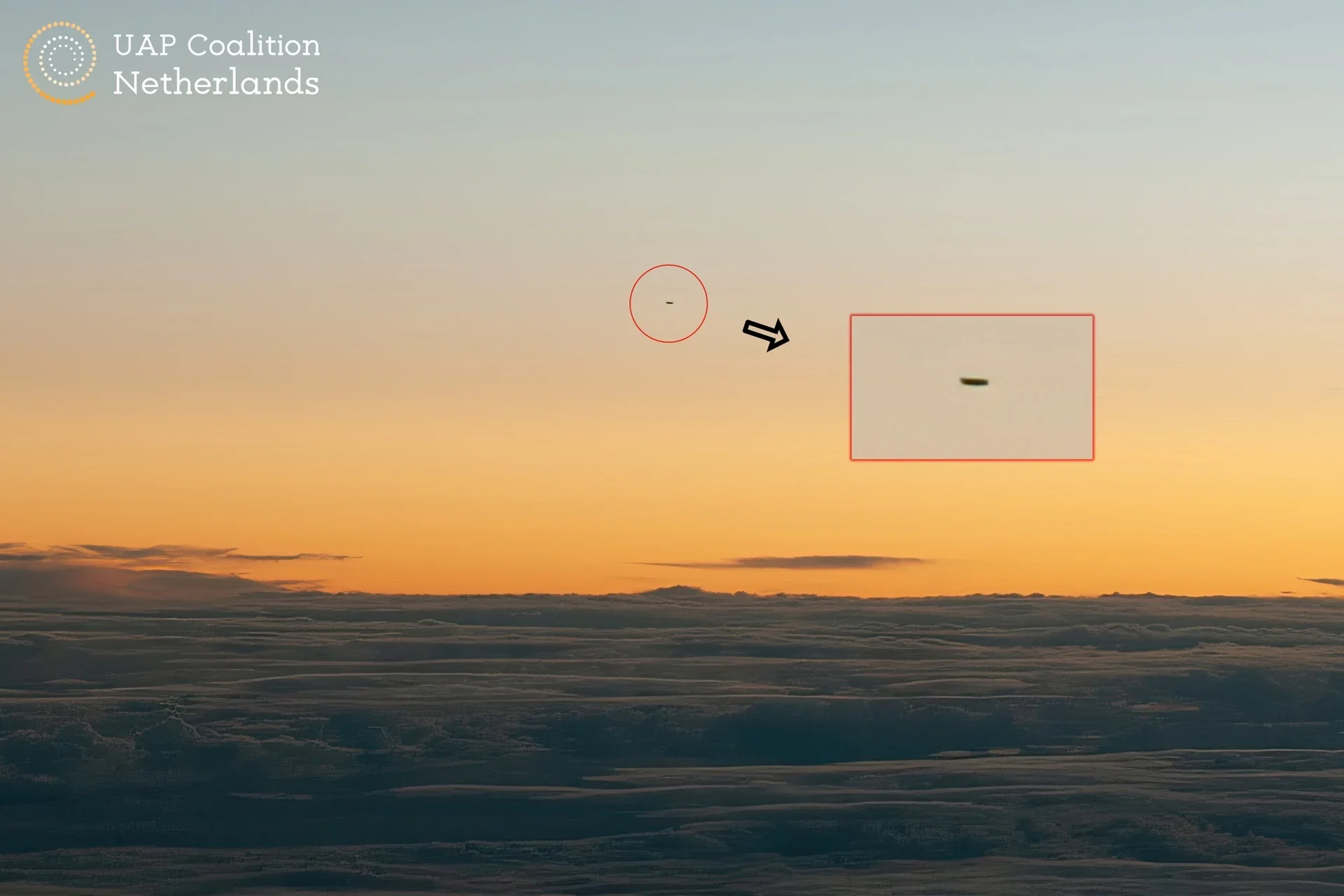

While Congressional hearings and the potential release of UAP files have dominated UAP headlines in the United States, a less publicized effort has been unfolding in Europe. In the Netherlands, a nonprofit organization representing aviation professionals, military personnel, and law enforcement officers has spent the past several years lobbying Dutch ministries, the European Commission, and Members of the European Parliament to treat UAP as a legitimate safety and research issue.
UAP Coalition Netherlands (UAPCNL) was founded by Joachim Dekkers, a former entrepreneur with more than two decades of organizational management experience. The Coalition functions as an NGO focused on destigmatizing UAP reporting for professionals who risk their careers by coming forward. In October 2024, the Dutch Safety Board, the Onderzoeksraad voor Veiligheid, or OVV, announced it would accept UAP reports from aviation professionals within its existing safety occurrence framework. The announcement followed direct dialogue between UAPCNL and the OVV earlier that year.
The OVV is an independent Dutch authority mandated to investigate safety-critical incidents in aviation, maritime, rail, and other sectors. Its willingness to acknowledge UAP as a reportable safety category represents the kind of institutional normalisation long sought by advocates.
Beyond the Netherlands, UAPCNL has pursued an ambitious EU-level strategy. In March 2024, the Coalition co-organised the first UAP event at the European Parliament in over 30 years, alongside former Portuguese MEP Francisco Guerreiro. Later that year, the Coalition coordinated a joint letter to EU institutions signed by 15 UAP organizations from across Europe, including Belgium, France, Germany, Sweden, and the United Kingdom. In 2025, a separate appeal to the European Commission, focused specifically on research stigma and backed by 36 co-signers including prominent scientists, was submitted as part of feedback on the European Research Area Act.
The European Commission's response has been cautious. In 2023, then-Commissioner Thierry Breton stated that the European Defence Agency held no documents relating to UAP and that UAP fell outside the scope of the EU Space Programme. No EU-wide UAP reporting mechanism currently exists, and EASA, the European Union Aviation Safety Agency, has no specific protocol for UAP data.
In its policy proposals to the Commission, UAPCNL has argued that existing ESA infrastructure like the agency's space debris monitoring systems and the Izana-2A laser station could be repurposed for UAP observation, generating scientific data while simultaneously enhancing satellite and astronaut safety. As The UAP Observer reported in April 2026, ESA has not ruled out future involvement in UAP-related work, though it currently has no dedicated program or budget line for it.
The following is an interview with Joachim Dekkers, conducted by The UAP Observer in March 2026, lightly edited for clarity.
Q: The Dutch Safety Board announced in October 2024 that it would begin accepting UAP reports from aviation professionals. Can you walk us through how that milestone was achieved?
A: "The journey toward this milestone began with strategic outreach in early 2024, with the objective of bridging the gap between reported pilot experiences and existing safety reporting structures. During our dialogue with the Dutch Safety Board (OVV), we focused on two pillars: flight safety and the duty of care toward aviation professionals. We highlighted that stigma can act as a barrier to transparent reporting, which is a fundamental risk to any 'Just Culture.'
The OVV reaffirmed that their existing reporting channels have always been, and remain, open to any safety related occurrence, including UAP. At the same time, the relevance of UAP within this context had not previously been highlighted. In that sense, the milestone is therefore an increased awareness and recognition that such reports fall within existing safety frameworks and will be treated with the same level of professional scrutiny. This is an important step in giving aviation professionals the confidence to report what they encounter without hesitation."
Q: How does the working arrangement with the OVV look in practice?
A: "Our role is complementary. When a professional contacts the Coalition, they speak confidentially with the Coalition Board or they receive a peer-to-peer consultation through our Ambassador Program, where they can speak confidentially with fellow aviators. However, we always encourage and facilitate formal reporting to the OVV. The OVV processes these through their standard aviation occurrence channels. While the Coalition provides a safe harbor for witnesses to process their experiences, the OVV maintains the official mandate to investigate if a report meets the criteria for a safety inquiry. Our coordination ensures that no data point is lost to the silence of stigma."
Q: The Coalition collects reports from professionals. Without compromising confidentiality, can you share whether any cases stood out as particularly extraordinary — and has the Coalition been able to draw any preliminary findings?
A: "Every case we receive is significant, not just due to the high level of technical detail provided by the witnesses, but because of the sincerity and courage it takes to come forward. While stigma is gradually receding, this remains a challenging topic for professionals to discuss. If I were to highlight two particularly striking accounts:
An airline captain reported a sighting in the 1990s and then, remarkably, witnessed an identical UAP 30 years later in the same geographic position. He described three lights performing intense, dynamic maneuvers. He described it as 'dogfighting.' When you connect those points of light, you have the classic triangular configuration that has been documented by witnesses globally.
We also have a documented account from a highly experienced Dutch helicopter pilot involving an encounter with a large, dark UAP directly above his aircraft. Most notably, during the duration of the sighting, all of the helicopter's communication equipment ceased to function. This occurred while flying in Iran decades ago and remains a definitive example of an UAP having a direct, physical effect on aviation technology.
Regarding patterns, we are seeing a consistency in geometric shapes and high-velocity maneuvers that defy conventional propulsion. These are not isolated 'glitches'. They are recurring observations by trained observers of physical phenomena that occupy the same airspace as our commercial and military flights."
Q: What has the reception been like at the EU level, and do you see a realistic path toward an EU-wide UAP reporting framework?
A: "The reception in Brussels has been encouragingly pragmatic so far. By focusing on flight safety, stigma and transparency rather than speculation on origins, we have found open doors within the European Commission and Parliament. We avoid the more sensationalist narratives, focusing instead on the 720 Members of [the] European Parliament['s] responsibility to ensure a safe and unified European sky. A centralized EU UAP reporting hub is a realistic but long-term goal. As we often say: this is a marathon, not a sprint. We are building the infrastructure for a permanent scientific and safety dialogue."
Q: Which international or European organizations does the Coalition work with?
A: "Collaboration is the cornerstone of our strategy, and we have proven that there is strength in numbers. In 2024, together with 15 UAP organizations from across the EU, the UK, and Norway we made a request to the European Commission for an official EU process to collect, analyze, and publish UAP data. We also urged for the integration of UAP into relevant aviation, safety, and space legislation, supported by dedicated funding for multidisciplinary research.
Building on that momentum, in 2025, we spearheaded a formal appeal to the European Commission, urging them to tackle the stigma hindering research in emerging fields like UAP. This initiative was supported by a group of 36 co-signers, comprising prominent scientists and fellow European UAP organizations.
We remain in close coordination to ensure this topic is handled with the scientific rigor it deserves. It is important that UAP organizations are recognized and work together in a formal, professional capacity. My message to your readers is simple: Get organized. Whether you join an existing group or start a new one in your country, collective action is the only way to move the needle on government policy. Governments may overlook an individual, but they cannot ignore a unified professional coalition."
Q: What are the Coalition's most important goals over the next one to two years?
A: "Our primary focus is the normalization of the UAP dialogue within the military, police, and aviation sectors. Over the next two years, we aim to move beyond 'acceptance' toward active policy integration. For example, we want to see UAP awareness included in flight crew, military and police briefings and safety manuals. To sustain this, we continue to rely on the support of our community. Our goal is a future where no person has to choose between their career and reporting the truth of what they saw and where scientists can perform research on UAP without any stigma or repercussions."
With UAPCNL, the Netherlands is emerging as one of Europe's pioneers on the UAP topic. The cases the Coalition has collected from professionals are, by Dekkers' own account, anything but routine. Their strategy — safety-framed and deliberately free of speculation — has already yielded tangible results, most notably in breaking down the stigma that has long kept pilots and other professionals silent. If there is a model for how to move the UAP conversation forward in Europe, this may well be it, and one can only hope that other EU member states and institutions are paying attention.
Joachim Dekkers is the founder and chairman of UAP Coalition Netherlands. The organization can be reached via their contact form and at uapcoalitienederland.nl.